
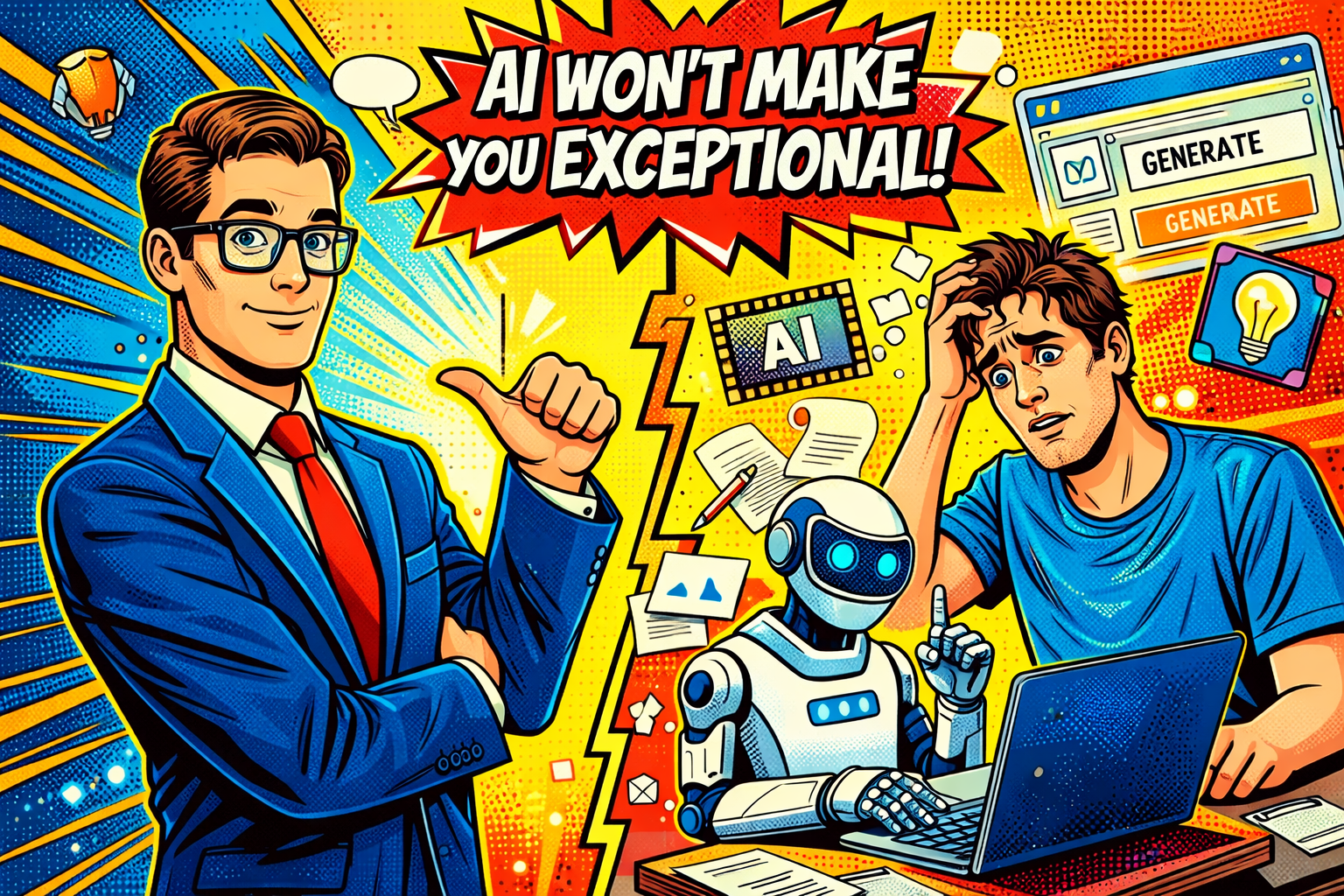
People who are not exceptional without AI will not suddenly become exceptional because of it.
There is a growing belief that artificial intelligence is the great equaliser. That with the right prompts and the right tools, anyone can become a filmmaker, a software developer, a designer, a strategist. AI can generate high-quality videos, write polished articles, design logos, draft code and even build functional apps. Entire workflows that once required years of training can now be initiated with a sentence.
The accessibility is extraordinary.
But accessibility is not the same as excellence.
AI has lowered the barrier to entry across countless creative and technical fields. What it has not done — and cannot do — is eliminate the importance of fundamentals. People who are not exceptional without AI will not suddenly become exceptional because of it. They may become faster. They may become more productive. But exceptional? That still depends on something deeper.
The Age of Abundance - and Slop
The proliferation of generative tools has already led to a flood of content. Articles, videos, graphics, apps - produced at speed and scale. Much of it is technically competent. Some of it is even impressive on first glance. Yet a large proportion blends into a growing mass of what critics call “slop”: content that is functional but forgettable.
The reason is simple. When models are trained on vast amounts of existing material, they are inherently optimising for patterns that already exist. They are excellent at producing the average of what has come before but are not inherently wired to produce genuine originality, strategic clarity, or meaningful insight.
And that gap is where human judgement becomes decisive.
Prompting Isn’t the Same as Understanding
Consider app development. Tools like Claude and other AI systems can now generate working code from a description. A user can request a task management app or a budgeting tool and receive something usable in minutes. For someone without technical training, this feels revolutionary.
But functional is not the same as exceptional.
An exceptional app requires architecture decisions, scalability planning, user experience design, security awareness, data modelling, and an understanding of how users actually behave. It requires anticipating edge cases and thinking several iterations ahead. AI can assist with each of these elements - but only if the person guiding it understands what to look for.
Without that foundational knowledge, users risk producing something that works superficially but fails under pressure. The prompts may be sophisticated, yet the output remains limited by the prompter’s understanding.
Simply put, AI does not replace expertise. It can either amplify it - or exposes its absence.
The Social Media Parallel
We have seen this pattern before.
When social media platforms emerged, they were heralded as tools that would democratise influence. In theory, anyone could become an influencer. Everyone had access to the same publishing tools, the same distribution channels and, in theory, the same opportunity.
And yet, only a small fraction of users became highly influential.
Why? Because access to a platform does not substitute for charisma, strategic thinking, storytelling ability, or an understanding of audience psychology. The most successful creators were often those who already possessed strong communication instincts or marketing acumen. They used social media effectively because they understood the fundamentals of persuasion, branding, and consistency.
They became popular in spite of social media - not because of it.
AI is following the same trajectory. It gives everyone access to powerful tools but it does not automatically confer the underlying qualities required to use them exceptionally.
The Real Differentiator: Taste, Judgement and Experience
Exceptional outcomes are rarely the product of tools alone. They stem from judgement - knowing what to keep, what to discard, and what to refine. They come from taste which is really the ability to distinguish between competent and compelling. And they rely on experience: the accumulated pattern recognition that allows someone to foresee problems before they materialise.
AI can draft ten versions of a proposal in seconds. It cannot decide which one aligns best with a nuanced client objective unless a human guides it. It can generate a marketing strategy outline, but it cannot feel the cultural moment in the way an experienced strategist can.
Those who already possess expertise will use AI to accelerate their craft. They will experiment faster, test ideas more efficiently, and iterate with greater precision. In their hands, AI becomes a multiplier.
However, for those without foundational understanding, AI may create the illusion of competence but not sustained excellence.
Multiplication, Not Transformation
Artificial intelligence is undeniably transformative in its reach. It is expanding access to creation in ways that were unimaginable a decade ago. That is a profound shift.
But transformation of tools is not the same as transformation of people.
AI does not turn mediocrity into mastery. Rather, it magnifies what is already there — creativity, discipline, insight, curiosity, strategic thinking. If those qualities are absent, AI will not invent them.
In the long term, the competitive advantage will not belong to those who simply use AI. It will belong to those who understand their craft deeply enough to use AI well.
The tools at our disposal may have changed. But the fundamentals have not.