
What Is the Point of the UK's AI Minister?
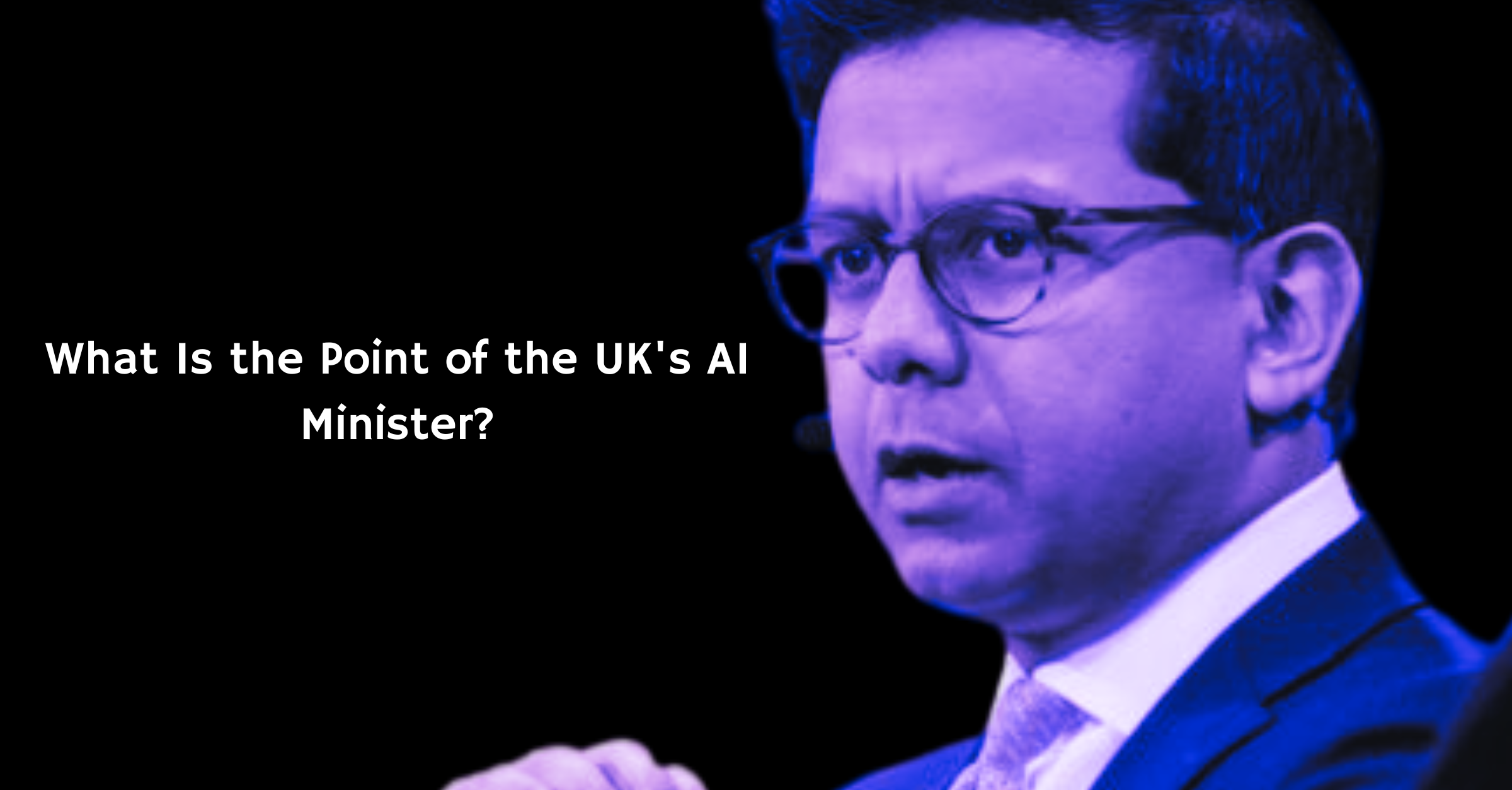
There is something undeniably significant about the UK appointing its first dedicated AI Minister. Kanishka Narayan now has a seat at the Cabinet table, with responsibility for one of the most transformative technologies in modern history.
The question is whether that appointment actually gives the UK what it needs to compete in the global AI race.
Narayan himself has described AI as potentially the most significant technology in human history, with the power to transform Britain's economy, national security and public services. That is quite a brief. Yet at precisely the moment AI is becoming a strategic priority, the government has also scrapped the Department for Science, Innovation and Technology (DSIT), splitting its responsibilities across other departments.
So, what exactly is the point of an AI Minister?
A Seat at the Table Is Not a Strategy
There is a strong argument that elevating AI to Cabinet level sends an important signal. The technology deserves political attention, and having a minister who understands the sector could help ensure AI remains high on the government's agenda.
Narayan brings experience of government, business and the technology ecosystem, having previously held responsibility for AI and online safety. His appointment therefore has genuine potential.
The problem is that one minister cannot build an AI economy alone.
The UK's AI ambitions depend on a vast ecosystem of infrastructure, investment, regulation, energy, talent and compute. The government faces questions around the availability of domestic data centres, reliable energy and the ability to provide sufficient compute capacity to support an expanding AI sector.
As one technology leader put it, without power there is no compute, and without compute there is no knowledge economy.
These are infrastructure challenges that cannot be solved through ministerial announcements.
Why Scrap the Department That Understands Technology?
Perhaps the most puzzling aspect of the appointment is the timing.
The government has created a dedicated AI Minister while simultaneously scrapping DSIT, the department specifically established to oversee science, innovation and technology.
That creates a curious contradiction.
On one hand, AI is being elevated to the Cabinet table. On the other, the specialist department that understood the technology landscape is being dismantled and its responsibilities redistributed.
There are arguments that a new structure could actually place AI closer to the centre of government. A more powerful, cross departmental approach could give the technology greater influence over economic policy and public services.
Yet the immediate concern is disruption.
The UK is already competing against countries with significant investment, infrastructure and technological ambitions. Any fragmentation of responsibility risks slowing decisions on AI safety, regulation and investment at precisely the moment the country needs momentum.
Narayan may be an excellent appointment. The question is whether the machinery around him is capable of matching the ambition.
The Global AI Race Is About More Than Ministers
The UK is not alone in recognising the political importance of AI.
The UAE appointed Omar Sultan Al Olama as the world's first Minister of State for Artificial Intelligence, while Canada has established a portfolio focused on AI and digital innovation. Albania has even introduced an AI generated virtual minister, Diella, to oversee public tenders and tackle corruption.
These examples demonstrate that governments are experimenting with different ways of placing AI at the heart of national strategy.
But titles and portfolios will not determine who wins the AI race.
The UK's real challenge is turning AI ambition into widespread economic adoption. Research suggests that many UK businesses are still struggling to derive meaningful value from their existing AI tools. There are also legitimate concerns about job displacement and whether the public will experience the benefits of AI before feeling its disruption.
That requires more than policy. It requires execution.
So, What Is the Point?
The UK's AI Minister could become an important role, but only with the authority and resources to make it meaningful.
Narayan has an enormous opportunity to help shape Britain's AI future, from improving adoption and strengthening AI security to supporting innovation and addressing the risks the technology presents.
Yet the appointment should not become a substitute for a coherent national AI strategy.
The UK needs investment in compute. It needs reliable energy. It needs a regulatory framework that encourages innovation while protecting the public. It needs businesses to actually adopt AI and generate measurable productivity gains. It needs a plan for workers whose jobs will be disrupted.
Most importantly, it needs government departments working together rather than technology policy becoming fragmented across Whitehall.
So, what is the point of the UK's AI Minister?
The answer should be to give AI the political leadership it deserves. Whether the appointment achieves anything beyond symbolism will depend on what happens next. Britain does not need another impressive sounding government title. It needs the infrastructure, investment and long term strategy to turn AI ambition into reality.
Narayan may have a seat at the table. Now the UK needs to make sure he has the tools to actually change the conversation.
If your B2B tech project wants to navigate the B2B tech media landscape with clarity and impact, I help teams develop cost-effective and results-driven communication strategies that combine PR, social media and SEO. Get in touch if you want to elevate your message, reach the right audiences and build sustainable growth in a rapidly evolving market.
Let’s have a chat : lekeapena@thenextmachinecomms.com